Posts tagged #kids

The Industrious Beaver

Thank you for reading my blog. I hope you are having a really good day.

I want to tell you a few more things about the Beaver, because they are such great engineers (builders), and so organized. I told you before that the Beaver builds a dam on a stream In order to form a pond for it, and it's family, to live in. But just how does it build this dam? The answer is the really neat part.

First the Beaver has to cut down some trees. Well "cut" isn't the right word , it's "chew". That's right, the Beaver uses its two front teeth to chew through the trunk of the tree to make it fall. You may have seen your father, or some tree men, cut down a tree with a chain saw. Well, imagine having to cut the tree down using your teeth. And the Beaver is so skilled at bringing down a tree that he can make it fall exactly where he wants it to fall.

After the tree is down, he chews off branches just the length he needs to build his dam. He will drag rocks and stones into the water as a base, or foundation, for his dam, and then bring in some larger branches to drive into the stream bottom; and others toweave between the branches and stones, along with some mud to put between the branches and stones to patch any holes. And, because the water in the stream might wash the interwoven branches away, he will include in the sides of the dam some longer, stronger branches that are not only woven between the branches and stones in the water, but also extend out onto the bank of the stream where they are anchored to large boulders, or the trunks of large trees. This gives the dam a great deal of strength, and keeps it from being washed downstream.

Keep in mind that all of this initial work is done underwater, where it's hard to see what you are doing. It's not until the very end of building the dam that you see the top part, where the stream is flowing over its top. But believe me when I tell you that most of the hard work is on the bottom, where you can't even see it.

And you know what? At the same time the Beaver is building the dam, he is busy building his house, which I told you about before. He needs to make the house just the right height too, so that when the pond is finished the level of the water is exactly right. If he builds the dam too low, he won't be able to have an underwater entrance. If he builds the dam too high, the pond will flood his living quarters.

Because the Beaver has no defenses against predators (just like us rabbits), he has to be in the water most of the time. (Us rabbits don't need to be in the water because we just outsmart predators). If he has to go under the water to escape danger, he can hold his breath for up to 17 minutes -- and that's pretty good. You probably have a hard time holding your breath for 1 minute. In the winter time he has figured out something else that helps him. And that is that when the pond freezes solid, he will let some of the water out of his pond, which lowers the level of the pond. That creates a space between the water and the underside of the ice, and the Beaver can breath the air in this space. The ice doesn't sink down as it is supported by the sides of the pond.

With all that to do the Beaver is the hardest worker in the animal world. And that's why you hear people say that someone who is working all the time is "busy as a Beaver!"

Keep you chin up

Robert P. Rabbit
The Woodchuck

Thank you for reading my blog. I hope you are having a very good day.

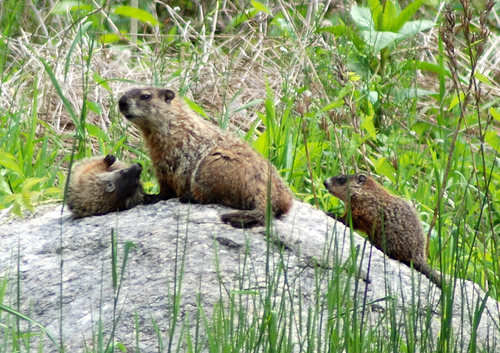
I have a friend in North Georgia whose name is Woody Woodchuck. In some parts of the USA they are called Marmots, but they are all still Woodchucks. Actually they were here when the first settlers came to America and spotted this little furry creature and decided to call it "Chuck". Then later, some bright person, for reasons nobody knows, started calling it a "Woodchuck", even though it doesn't eat wood, chew wood or have much of anything to do with wood.

The Woodchuck lives in a den it digs on the side of a hill - to keep its house from flooding. It is an excellent digger, moving as much as 700 pounds of dirt in the process of building a bunch of tunnels and rooms. It will have a room for a nest, one for a bathroom, and rooms for each newborn (called "chucklings") to have its own place to sleep once it's big enough to walk around on its own. The Woodchuck is so organized that it will have a main entrance to its den that is noticeable by the piles of dirt from the digging, and then an escape exit a good distance away that it digs from the bottom up, taking the dirt out the front entrance so that when he breaks through to the surface, he doesn't even disturb the vegetation around the exit. In this way none of his predators know where he will come out of the ground when he needs to escape.

With all that digging, you would think the Woodchuck would be very dirty, but in fact, they are very clean animals -- always cleaning themselves. You will never see a Woodchuck with so much as a single bit of dirt on its fur.  And mama Woodchuck will clean the den, which can be 5 or 6 rooms, and 75 feet of tunnels, every day, and will replace the nesting material whenever it gets soiled.

By the way, just like the bear, the Woodchuck hibernates, which means it sleeps all Winter.  But one of the most interesting legends about the Woodchuck is that in each territory where they live, they will elect one of their group to predict on February 2nd of each year when Springtime will arrive. On that day,  the Woodchuck will wake up, and come out of its den in the morning. If it sees its shadow, it will go back in its den and sleep for six more weeks, as it knows Spring is six weeks away. If it doesn't see its shadow, it will start its work for the Season, as it knows Spring is just around the corner.

Usually the Woodchuck is more accurate than the TV Weatherlady. Maybe she needs to go to Woodchuck Weather School.

Keep your chin up.

Robert P. Rabbit

Robert P. Rabbit Makes it to the Nation's Capital!

Arielle spent a few days delivering books to several children's hospitals and Ronald McDonald houses in the Washington, D.C. area!  We are now officially in the nation's capital.  It was a fun trip and met some great people.  Take a look at the pictures!

Arielle in front of Inova Children's Hospital

Arielle in front of Inova Children's Hospital

Arielle with the man himself.

Arielle with the man himself.

What a beautiful welcome!

What a beautiful welcome!

Getting in a little sight seeing in between book deliveries. Robert P. Rabbit was very impressed.

Getting in a little sight seeing in between book deliveries. Robert P. Rabbit was very impressed.

The Amazing King Salmon

Thank you for reading my blog. I hope you are having a good day.

Being a rabbit, I don't like the water. It's wet, usually cold, or even icy, it makes me shiver when I'm drying out and I can't hop as well if my fur is so heavy with water. But there is one creature that lives in the water that I think is amazing. It's a fish, and they call it a King Salmon, and it can teach us a lot about determination.

Let me explain. In the Fall, mama Salmon will lay 30,000 eggs (one thousand at a time) in a small stream in the Northwestern United States -- Like Washington State. Within 15 seconds of the eggs hitting the floor of the stream, papa Salmon must fertilize them, or they will never hatch. He does this by covering them with a milky substance. Mama will then cover the eggs with sand and gravel by swishing her tail back and forth. The eggs will stay there all winter while a tiny tinny fish develops inside. Then, in February, 30,000 little biddy salmon all come out of their eggs. And since hundred of salmon lay their eggs in the same stream, that means millions of little salmon come out at once.

And this is where their adventure begins. They stay under rocks while they grow bigger feeding on the egg sack of food that they hatched with, but that soon runs out and they have to leave the safety of the rocks to go find food. Then the danger comes. They can freeze if the water gets too cold; die from too much sun; get eaten by bigger fish; get caught by birds, weasels, turtles, frogs or any one of a number of other predators; or can get washed down stream by heavy rain.

If they survive all of that, they swim to the first lake they come to, and start growing bigger so they can follow the stream all the way to the Pacific Ocean. There are still dangers in the lake, but they persevere (which means they don't give up) until they are big enough to swim to the Ocean. When they are hiding under the rocks it's called their "fry stage". When they are growing in the lake, it's called their "smolt stage". And when they are swimming down to the ocean it's called their " parr stage". And what's interesting, is that when they reach the place where the stream goes into the ocean, they have to wait until their body changes to the point where they can live in the salt water of the ocean. The river is fresh water, with no salt in it, so this is a change they need to make, because if they just swim from the fresh water into the salt water without making this change, they would die.

Finally, only one King Salmon of every ten that hatched upstream makes it all the way into the ocean -- nine of them die along the way. And in the ocean they swim as far down as 100 feet to escape all the bad things that want to eat them, and then they come to the surface to feed at night, when it is safer for them. They will stay in the ocean for about four years, traveling in a big circle from the Northwestern Territory (Washington and Oregon) all along Alaska and then back to where they started-- going hundreds of miles in the journey. By some magic God has put into their brains they come back to the very stream they were born in four years earlier. And remember, they've only been there once in their life before, and they still find it.

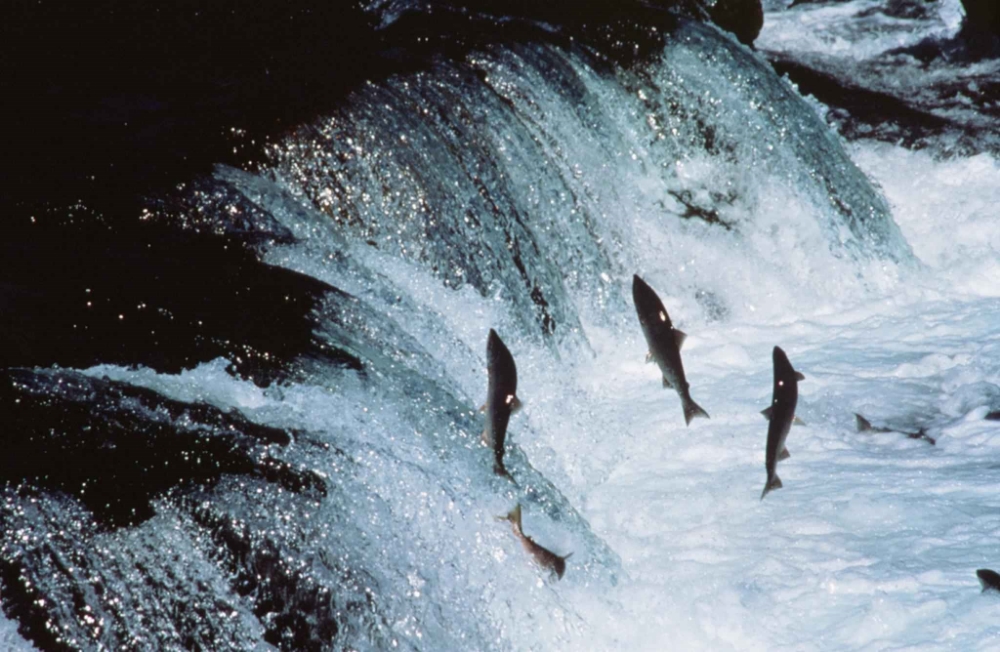
And their determination is still just as great. They will swim up this stream as many as 25 miles a day for weeks, and even months. They have to swim against very fast currents; swim up steep waterfalls; and dodge bears, otters, weasels and other predators. And they don't spend any time eating anything at all while they are doing it. They have only one purpose in making this long and hard trip, it's just so they can lay their eggs in the exact same place they were born.

Now that'swhat I call real determination. I wish I had half as much determination. If I did, I could sure get a lot done.

Keep you chin up.

Robert P. Rabbit