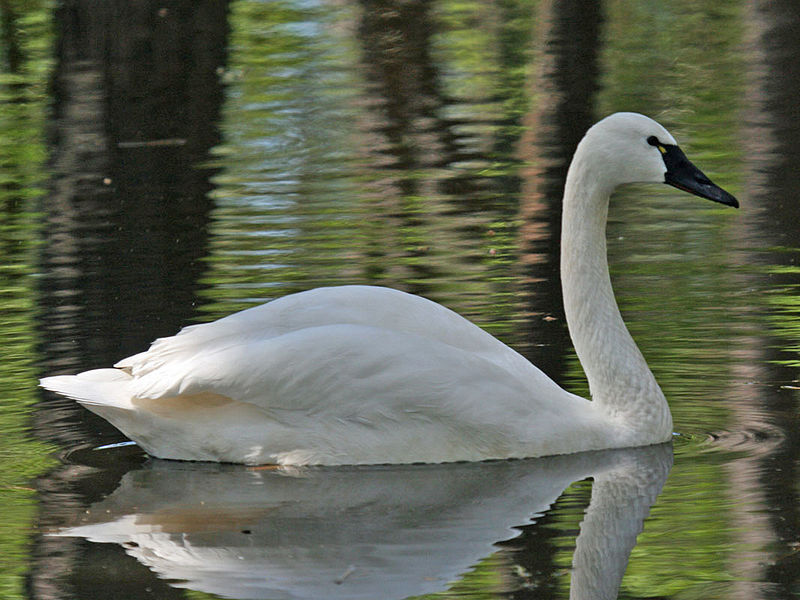
Image by Dick Daniels of Carolinabirds.org
Thank you for reading my Blog. I hope you are having a very good day.
Have you ever gone to a pond where there are beautiful, white long necked swans? They float around on the water with a majestic look about them, with theirimpressive long curved necks. They are a favorite of the children who live in Tallulah Falls, Katie's hometown in the Appalachian Mountains of North Georgia.
When you see them slowly swimming around the pond, you'd never know that each year they have to make an incredible journey to the far north to nest, lay their eggs and raise their young which, by the way, are called a really strange name. Baby swans are called " Cygnets". Get your parents to pronounce it for you, and then go ask your friends if they know what a "Cygnet" is. They probably won't have any idea, so when you tell them what one is they are going to know you are really smart.
Anyway, to get to where they need to go every Spring, the swans sometimes have to fly over 2,500 miles -- a really long way. They will fly in groups of as many as 500 birds. You won't see them, though, as they will be as high as 6,000 feet --- over a mile up. And they fly almost 100 miles an hour, which is way faster than your parents drive on the fastest interstate highway.
But the most wonderful thing about the swan is that they would never be able to fly that far if they didn't help each other out. You see, they fly in a V formation. That means that one swan leads the way, and all the rest spread out behind this leader in the shape of a big V. Look at the letter V that is in this paragraph at lest 5 times. Imagine the lead swan is at the point of the V, and the rest are lined up along the edges of the V. Now here is why that is so important.
Have you ever held your hand out the window of the car while it is going really fast? Remember how strong the wind was against your hand? Well that is what happens to the lead swans. The wind in really strong against them, and they cause the wind to slide off to either side, so that the wind hitting each swan along the V behind them is going to be less than half as strong. But having to be the one "braking" the wind in this way tires the leader out much faster than the ones behind. So they have learned to help each other by letting the lead swan drop back in the line when he, or she, gets tired. When that happens, another swan moves forward to take the lead.
It is helping each other in this way that enables the swans to make such a long journey. If they didn't do that, they would never get to their nesting ground, and then they couldn't lay eggs, and then there would be no baby swans, and soon there wouldn't be any more swans at all.
You can take a lesson from the swan. It's always good for everyone if we help one another.
Keep your chin up.
Robert P. Rabbit