
Thank you for visiting my blog. I hope you are having a really good day.
Us rabbits have never had much use for bees. It's not that we don't like them, we just don't eat honey like you do, and bees make an awful lot of honey. And I'll tell you something really interesting. When God made the bee, he made one of the most complicated and efficient machines ever. I mean, it takes a lot to be a bee ( hey, that sounds neat. I think I want to be a bee - well, not really, I like being a rabbit).
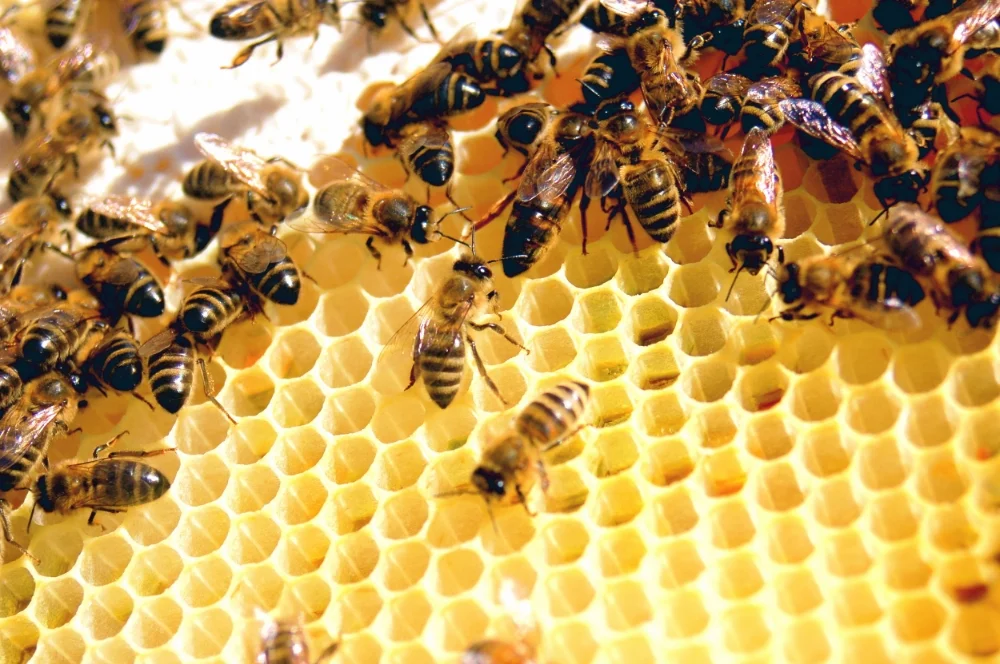
The bee hive is where the bees spend their lives. There are as many as 60,000 bees in a hive (that's because the queen bee - and there is only one queen bee - lays two or three thousand eggs a day ) and one kind of bee, the worker bee, passes through six different cycles in its short life. That means it will have six different jobs as it grows up.
When it first hatches out of its egg it is a cleaner bee. That means it cleans up the cells in the hive where the queen lays the eggs. Next it becomes a nurse, feeding honey to all the larva that will become the new bees. After that it becomes a storer of honey; then a repairer of the hive where it might be damaged; then a guard to keep predators away who would steal their honey, or eat the larva; and finally it becomes a scout that goes out looking for honey. They also build the hive from the very beginning. If you have ever seen a honeycomb, you can tell what a great job they have done. It is perfectly shaped, with each eight sided cell the exact size it needs to be. And it is made in such a way that none of the honey they make will leak out if the hive. Now if you want to see how cool that is have your mother pour some honey into your hand and then turn your hand over and see if you can hold the honey in. I'll bet you anything it all leaks between your fingers.
And all of the bees talk to each other in very strange ways. Inside the hive if there aren't enough bees doing a certain job, they all seem to know it, and they begin a moaning sound that goes throughout the hive. They keep it up until just enough bees change jobs to where the colony is balanced again. That means some of the workers will skip a job and maybe jump up to jobs where they might be needed. When they are in balance again, they stop moaning. I think if I was a worker bee I'd figure out which job I like best and jump right there as soon as I was allowed.
But the most interesting communication between bees comes from the scouts. They are the ones who go out looking for flowers that have lots of nectar, and when one scout has found a good source, that scout must come back and tell the bees that are going to gather the nectar just exactly where it is. They do this by first walking in circles once they are back at the hive. If they do just one circle, the nectar is closer than 300 feet; and if they make a figure eight, it is over 300 feet. Then they point their bodies either up or down. Up means the nectar is toward the sun, and down means it is away from the sun. And by vibrating really fast or slow they can tell the other bees the exact distance, and precise direction. And this is really important because the gatherer will take only enough honey to get to the nectar. That's because it wants to leave lots of room to bring lots of nectar back. If the nectar is further that it anticipated, it will run out of honey to eat for the energy it needs to fly, and it will drop to the ground and die. So the scout really has to be good about communicating to the other bees, or a lot of gatherers will really be made at that scout.
When a bee gets back with lots of nectar, it transfers it to others in the hive who then take it inside to be stored for food. While they are carrying it in their stomachs, it is being made into honey so that when they spit it out, it has become just what you see in the jar of honey on your breakfast table.
Ok, I'm sorry to be the one to have told you that the honey you eat came directly from the stomach of a bee, but that's the truth of it. But don't worry about it, honey is one of the purest foods there is in the world, and Katie tells me it even serves as a medicine for lots of illnesses you humans seem to get. In fact, GrandDad says he takes a tablespoon of honey every day, and he's really old, so it must be doing some good.
Keep your head up
Robert P. Rabbit